A Quote Beyond the Part
The installed price covers more than a retail breaker. A useful quote accounts for the service call, diagnostic testing, the replacement part, installation, and testing under load.
At Phoenix Electrical Panel Upgrades, we quote breaker replacement after a load test and visual inspection. A standard single breaker replacement in the Phoenix metro typically costs $150-$350 including labor and parts. The inspection helps determine whether the problem is a failed breaker, an overloaded circuit, or a larger panel issue that changes the price.
The installed price covers more than a retail breaker. A useful quote accounts for the service call, diagnostic testing, the replacement part, installation, and testing under load.
Standard thermal-magnetic, AFCI, GFCI, and dual-function breakers have different prices. The replacement must also match the panel and bus bar; amperage and pole count affect the scope.
Ask the electrician to confirm whether the fault is in the breaker, the circuit, or the panel. Replacing a breaker without diagnosing a downstream short or overload may leave the original problem unresolved.
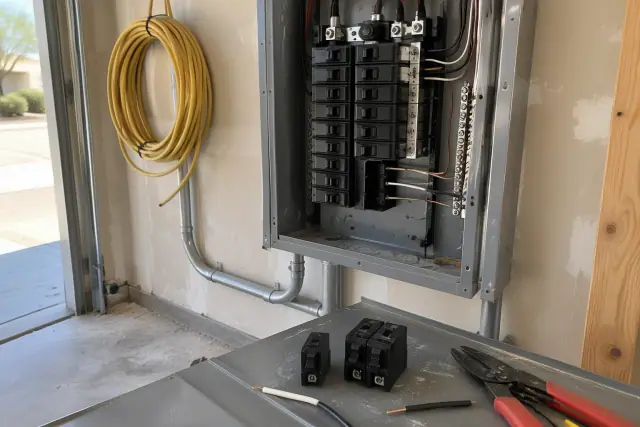
Single-pole breakers commonly serve 15A or 20A circuits; double-pole breakers supply 240-volt equipment such as ranges and HVAC condensers. These differences help explain why replacement quotes vary.
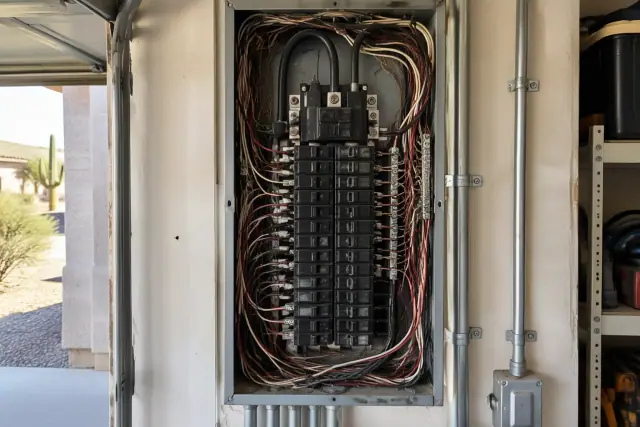
Crowded panels, corroded lugs, and limited access can turn a straightforward swap into more involved work. Panel condition matters as much as the replacement part.
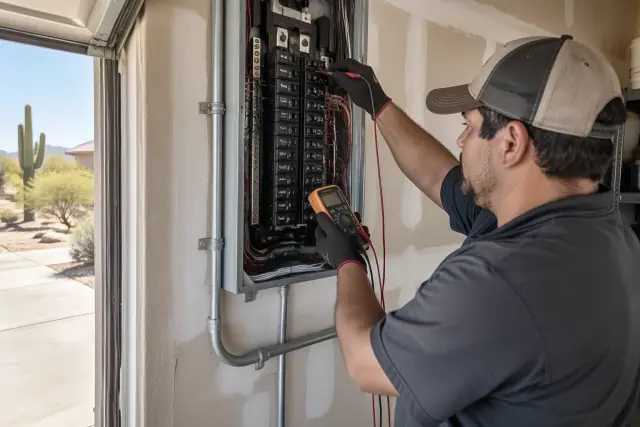
Load testing helps distinguish a failed breaker from a downstream short or overloaded circuit. Combined with a visual inspection, it helps establish the repair scope before a price is quoted.
Typical trip fees run $75-$150, with diagnostic or load testing listed at $75-$150. Flat service pricing may bundle those items, so ask what is included before comparing quotes.
Flat labor charges commonly run $150-$300 for a straightforward swap taking 30 to 90 minutes on site. Tight attic access, July heat, or corroded connections can increase the time needed.
Standard breakers typically cost $5-$40 for the part; AFCI/GFCI options often cost $50-$150. Parts for discontinued panels, where available, can run $100-$300 or more before installation.
Permit costs, when panel work requires one, typically run $75-$200. Ask whether the quote includes any applicable City of Phoenix or Maricopa County permit and the associated paperwork.
Typical Phoenix-area costs vary with breaker type, access, and panel condition. Specific amperage rows overlap the broader single-pole and double-pole categories; each row describes a job scope, not an added charge.
| Job scope | Typical cost | What the range covers or what changes it |
|---|---|---|
| Standard single-pole replacement | $150-$350 | Typical installed swap, including labor and the part; commonly 15A or 20A. |
| 15A breaker replacement | $150-$300 | Installed breaker for standard lighting and outlet circuits. |
| 20A breaker replacement | $150-$325 | Installed breaker for small-appliance circuits. |
| Double-pole replacement | $250-$450 | Larger part and connection checks for 240-volt circuits, such as a range or HVAC condenser. |
| 30A double-pole replacement | $250-$400 | Double-pole part and labor for equipment such as a dryer. |
| 50A breaker replacement | $300-$500 | Replacement for higher-load equipment such as an HVAC condenser or EV charger. |
| Main breaker replacement | $300-$800 | Scope varies with amperage and panel access. |
| Subpanel breaker replacement | $200-$400 | A breaker within a subpanel; confirm the part and labor included. |
| Breaker sourcing for discontinued panels | $200-$500+ | Availability can limit a breaker-only repair; clarify sourcing charges in the quote. |
| Full panel replacement, 100-200A | $1,550-$5,200 | Replacement of the panel rather than a single breaker; a different project scope. |
Installed replacement ranges differ from retail part prices. For discontinued panels, ask whether sourcing is feasible and compare the total with a full panel replacement.
A replacement quote should cover diagnosis, a compatible part, manufacturer-specified torque, and testing under load. Some pricing separates a $150-$200 service call, $150 for troubleshooting, and another $150 for circuit restoration; other companies bundle those tasks. Ask which charges are included, whether labor is flat or hourly, and whether an urgent-call trip fee is extra. Nationally reported averages of $100-$382 for a standard swap and broader project ranges up to $795 cover different scopes and markets, so compare local quotes for the same work. Combining a needed breaker replacement with already-planned panel work can spread the service call across one visit.
Phoenix housing ranges from 1950s Sunnyslope bungalows to newer subdivisions, so panel age varies block by block. In Arcadia, Encanto, and parts of Ahwatukee, some panels date from the 1960s and 1970s. With discontinued equipment, ask the electrician to compare a breaker-only repair with full panel replacement; limited parts availability can make repeated swaps a poor long-term choice. Summer cooling demand and monsoon surges also make circuit condition relevant. If you are planning a 200 Amp or 400 Amp service upgrade, a subpanel, or a whole house surge protector, have the existing breakers evaluated as part of that work.
Can the job take longer than a breaker swap? Yes. If inspection finds a failing panel, a full replacement may take a half-day or full day. Can a breaker be repaired? Its sealed internal components are not normally repairable; a temporary overload needs a different diagnosis from a failed breaker. How long do breakers last? Typically 30 to 40 years, with heat, moisture, and heavy load cycling shortening that lifespan. A panel original to a home built before the 1990s merits evaluation even without recent trips. Can I replace one myself? Have an electrician handle the work: exposed energized parts, an incompatible breaker, or an improperly tightened connection can cause serious harm. Will insurance pay? Coverage depends on the cause and your policy; ask your carrier and keep the electrician's findings.
Share when the circuit trips, which equipment it serves, and any known panel age or access concerns. Repeated tripping, buzzing, scorching, or a burning-plastic smell warrants prompt professional evaluation. Phoenix Electrical Panel Upgrades bases the estimate on a visual inspection and load test so the proposed work addresses the cause.